
Here’s a quiz for you:
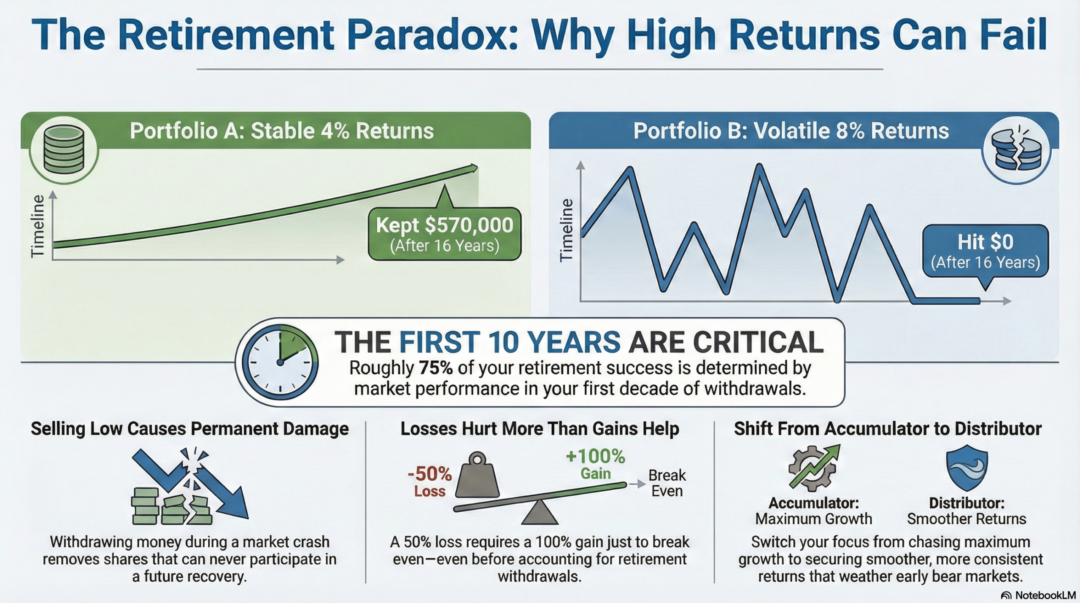
Two portfolios. Same starting balance of $1 million. Same 16-year period from 2000-2015. Both take $50,000 per year (adjusted for inflation) to fund retirement.
Portfolio A: 100% stocks, earned 8.08% average annual return
Portfolio B: 100% bonds, earned 3.87% average annual return
Which portfolio lasted longer?
If you picked Portfolio A (stocks), you’re in good company. That’s what 95% of investors would choose. It seems obvious—double the return should mean longer-lasting money, right?
But you’d be wrong.
Portfolio A ran completely out of money by mid-2015. Portfolio B still had $570,000 left, more than half the original balance.
How is this possible? How did the portfolio with HALF the return outlast the one with double the return?
The answer reveals one of the most important—and most misunderstood—truths about retirement investing.
The Rules Change When You Start Taking Money Out
During your working years, the investment rules are pretty straightforward: maximize returns, ride out the storms, and let compound growth work its magic. A bad year? No problem—your next paycheck goes in anyway, and you’re buying shares at lower prices.
But retirement flips the script entirely.
Now you’re taking money OUT, not putting money IN. And that changes everything about how volatility affects your wealth.
The Math That Makes Volatility Deadly
Let’s talk about something uncomfortable: losses hurt more than gains help.
If your portfolio drops 30%, you need a 43% gain just to get back to breakeven. Drop 50%? You need 100% gain to recover.
Now add withdrawals on top of that, and the math becomes brutal.
This is why, in retirement, it’s not about having the highest return. It’s about avoiding big losses… and most importantly, lost decades.
Even With Advisory Fees, the lower returns still win
“But what about fees? Won’t higher fees hurt the bond portfolio?” you might ask.
Fair question. So I ran the analysis again with a realistic 1.5% annual management fee applied to BOTH portfolios—typical for comprehensive advisory services that include financial planning, investment management, and retirement income planning.
The result? Bonds STILL crushed stocks.
Portfolio Performance With 1.5% Annual Fee (2000-2015)
Portfolio A (Stocks) Portfolio B (Bonds)
Starting Balance: $1,000,000 $1,000,000
Ending Balance: $0 (depleted) $570,236
Portfolio Lasted: 15 years 16+ years (ongoing)
Even after paying identical 1.5% advisory fees throughout the entire period, the bond portfolio maintained over half its original value while the stock portfolio was completely depleted.
This proves something critical: the impact of volatility during the withdrawal phase completely overwhelms the impact of fees. Managing sequence of returns risk matters far more than minimizing expenses when you’re taking distributions.
The Behavior Trap: Recency Bias
So why do most retirees make the mistake of chasing higher returns without considering volatility?
Because of something called recency bias—our tendency to assume recent trends will continue forever. Read: The Bias Buster Investment Strategy
You built your wealth in one of the greatest stock markets in history. You saw your 401(k) grow nicely (on average) through multiple market cycles. That experience is burned into your brain.
So when you retire, it feels natural to keep doing what worked. Stay aggressive. Keep that stock exposure high. The long-term average says stocks win.
But here’s the brutal truth: your retirement portfolio doesn’t live in the long-term average. It lives in your specific path of life, and you have no control over your path of returns in retirement.
What This Means for Your Retirement Strategy
Now, before you panic and dump all your stocks for bonds, let me be clear: This analysis isn’t suggesting retirees should hold 100% bonds.
That would introduce different problems, inflation risk, opportunity cost, and potentially running out of money in a different way if you live to 95.
The point of this analysis is simpler and more profound:
In retirement, you need to treat your retirement portfolio differently.
That means:
✓ Prioritizing downside protection over maximum returns
✓ Building strategies that can weather early retirement bear markets
✓ Accepting lower long-term averages in exchange for smoother, more consistent returns Read: Should You Pursue Consistency or Rely on Luck?
✓ Focusing on “what’s the worst that could happen” rather than “what’s the best that could happen”
Some practical ways to do this:
1. Global Asset Allocation: Globally diversified, low-cost ETF buy & hold portfolio with a 20% or more allocation REAL ASSETS (i.e., Gold, Commodities, Real Estate, TIPS, etc.). Read: Investing 101 and 102
2. Tactical Asset Allocation: Use systematic strategies that can reduce equity exposure when markets show warning signs and increase it when conditions improve. (This is what we do at Calculated Wealth with our dual momentum approach.) Read: Tactical Asset Allocation: Navigating and Unknowable Future
3. Dynamic Withdrawals: Reduce your spending during bear markets instead of rigidly taking the same inflation-adjusted amount regardless of portfolio performance.
The Question That Changes Everything
The next time someone shows you historical returns and suggests the higher-returning portfolio is obviously the better choice for retirement, ask them this:
“Yes, but which portfolio will protect me during the inevitable bear market that happens in my first 10 years of retirement?”
Because that’s the question that matters.
Our example wasn’t theoretical—it was real data from actual portfolios during an actual retirement period. And it showed definitively that the portfolio earning 3.87% outlasted and outperformed the portfolio earning 8.08% when withdrawals were involved.
In retirement, volatility isn’t just an inconvenience. It’s a wealth destroyer.
The traditional accumulation mindset of “maximize returns and ride out the storms” can actually undermine your retirement security. You need a different approach—one that recognizes the unique mathematics of taking distributions from a portfolio.
You only get one shot at retirement. Make sure you’re asking the right questions about how your portfolio is designed to handle that reality.
Frequently Asked Questions
Q: Can you provide a link to the actual research?
A: Yes! Click here to download the Portfolio Visualizer analysis showing both the no-fee and 1.5% fee scenarios. MELISSA – I WILL LINK THIS AFTER YOU POST IT ON THE WEBSITE
Q: Aren’t you cherry-picking the worst period in history?
A: Yes, I intentionally chose this period because that’s the point—what if YOUR retirement coincides with this exact sequence? We don’t get to choose our path in retirement. We can’t control it. Why risk your retirement betting that your retirement won’t follow a similar path? This exercise demonstrates the critical importance of volatility management. We naturally gravitate toward rates of return, but rates alone don’t tell the full story in retirement
Q: Boglehead here—what about diversification? 100% stocks vs 100% bonds is unrealistic.
A: Fair point. This is a controlled experiment to isolate volatility’s impact. It’s also why I recommend Global Asset Allocation.
There’s also “VTI and chill.” However, this is exactly that scenario. How chill will you feel when you’re bankrupt in 15 years or make a substantial lifestyle adjustment a few years into retirement?
Q: Engineer mindset—what’s the statistical significance? Isn’t this just one data point?
A: Yes, this is a sample size of 1. But throughout history, there are other “lost decade” periods like 1966-1982, Japan 1990s, and others. The point isn’t statistical significance—it’s demonstrating what happens when volatility strikes early retirement. This shows why managing volatility matters more than optimizing for maximum return based on recent history.
Q: But stocks have always outperformed long-term. Why not just hold through?
A: Long-term averages assume accumulation + recovery time, but we’re not entitled to recovery. Japan peaked in 1989 and took 34 years to recover—still down 26% even with dividends. I’m hugely optimistic about US equities long-term, but the future is unknowable. Why bet your one shot at retirement on something with no guarantees? We’re focused on prudent risk management, not predicting the perfect portfolio. That’s why we recommend systematic TAA (dual momentum) or global asset allocation diversification.
Want to dig deeper into how sequence risk affects retirement portfolios and what strategies can help? Check out our whitepaper “The Retirement Portfolio” or schedule a complimentary introductory call to discuss your specific situation.
Continue reading more of our insights by visiting our resources page. If you’re ready to see how we can partner with you on your wealth plan, please contact us today for a complimentary introductory call.