
The Investment Marriage Problem
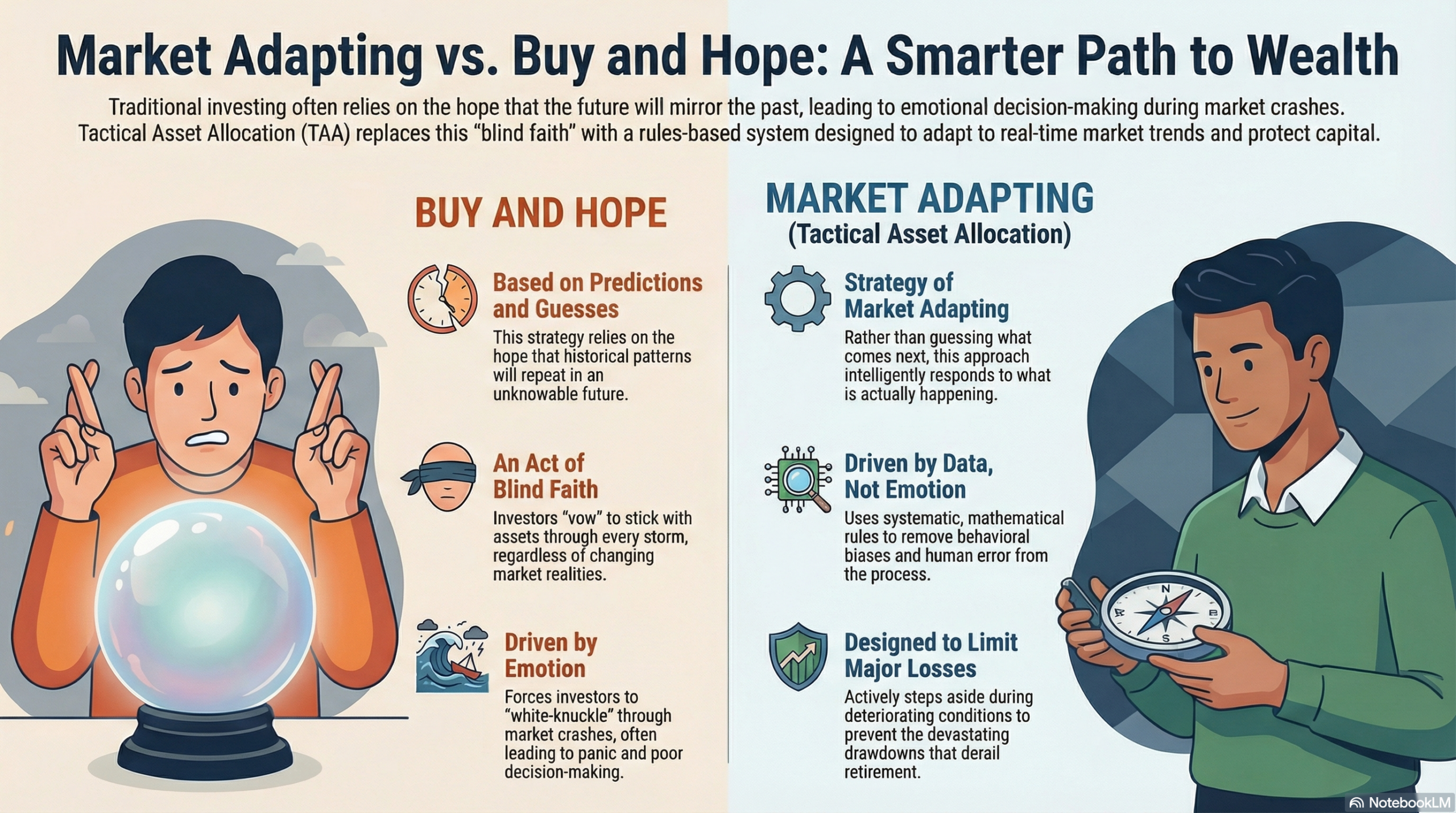
Buy-and-hold investing is like a marriage vow: "for better or worse, till death do us part." You pick your assets, promise to stick with them through every storm, and hope your faith is rewarded. But what if the next decade looks nothing like the last? What if your portfolio's charming quirks become devastating flaws?
The uncomfortable truth: the future is unknowable. Nobody has a crystal ball to predict which asset class will lead next year, in five years, or over the next decade.
The Fatal Flaw of "Hope and Hold"
Traditional buy-and-hold strategies require an act of faith that your chosen assets will always bounce back, that historical patterns will repeat forever, that you can endure 30-50% drawdowns without flinching. This approach works until it doesn't.
Consider this: during the 2000-2002 and 2007-2009 bear markets, buy-and-hold investors watched their portfolios get crushed as they waited for the "inevitable" recovery. Some recoveries took years. Others never fully materialized for certain assets.
But here's what buy-and-hold philosophy misses: not all decades are created equal. Japan's lost decades, the 1970s stagflation, and the 2000s "lost decade" for U.S. stocks weren't temporary blips. They were extended periods where traditional 60/40 portfolios stagnated or worse. You can't bet your retirement on the assumption that every 10-year rolling period will deliver prosperity in US stocks and bonds. Economic regimes change, and a strategy designed only for U.S. prosperity becomes a liability when that regime shifts.
For retirees, this math becomes devastating. When you're taking distributions from a declining portfolio, every dollar withdrawn during a downturn is a dollar that can never compound back. This is the sequence-of-returns risk, and it's the silent killer of retirement dreams.
Learn more about how the sequence of returns risk devastates retirement portfolios.
The mathematical reality of portfolio losses means a 50% loss requires a 100% gain to break even, and retirees taking distributions don't have time for that recovery.
First, Fix the Foundation: Global Asset Allocation
Most investors never escape the pull of a U.S.-centric 60/40 portfolio. It's fueled by recency bias—the past 15 years of U.S. dominance have made it feel like the only sensible choice.
A small sprinkle of international equities helps, but it's rarely enough. Investing 101 shows that to truly navigate inflation and build resilient sources of return, you need a meaningful allocation—at least 20%—to real assets like gold, commodities, and REITs.
This global foundation meaningfully outperforms a U.S.-only approach during inflationary periods without significantly sacrificing returns during periods of prosperity. The key insight: different asset classes dominate during different economic regimes. Commodities and gold shine during inflation, bonds excel in deflation, and international stocks lead during U.S. stagnation. Once you understand this, tactical asset allocation becomes a natural enhancement: adapting that stronger mix to current trends for even better risk-adjusted results, especially in retirement.
A Smarter Path: Tactical Asset Allocation
Tactical Asset Allocation (TAA) offers a fundamentally different approach. Instead of hoping the future mirrors the past, TAA uses systematic, rules-based strategies to adapt to changing market conditions.
TAA works because it's built on three powerful principles:
- Trend Recognition: Markets don't turn on a dime. They give signals. TAA captures these signals through mathematical models that have worked for over 100 years (AQR study; SSRN paper).
- Risk Management First: Rather than riding every storm, TAA steps aside when conditions deteriorate and re-engages when trends improve. You participate in the upside while limiting devastating drawdowns.
-
Regime Adaptation: By rotating between asset classes based on momentum across multiple lookback periods, TAA positions you for whichever economic regime emerges—growth, inflation, deflation, or stagnation—without requiring you to predict which one comes next.
Research spanning over a century shows that trend-following approaches (the foundation of TAA) have consistently outperformed buy-and-hold strategies while reducing risk:
- Lower Drawdowns: TAA strategies often limit losses to 15-20% while buy-and-hold can suffer 50%+ declines (Allocate Smartly)
- Better Retirement Math: For portfolios taking distributions, TAA can extend portfolio longevity by decades through superior withdrawal rate support (SSRN: Can Sustainable Withdrawal Rates be Enhanced by Trend Following?)
- Smoother Returns: Less volatility means better compounding and fewer sleepless nights
Historical analysis reveals that during major bear markets from 1950-2018, while the S&P 500 averaged -33.8% losses, well-designed TAA strategies averaged +0.9% gains during the same periods (Optimal Momentum).
Important Caveats About Historical Performance
These historical results, while compelling, come with important limitations you should understand:
Historical backtests involve data-mining risks and are necessarily fitted to past market cycles that won't repeat exactly. Momentum strategies have grown more popular over time, which can erode edges through crowding effects. Our actual implementation uses multiple lookback periods (not just a simple 12-month momentum as shown in basic illustrations) to diversify across signal timeframes and reduce overfitting to any single measurement period.
We've validated our approach through out-of-sample testing, but past performance is not a guarantee of future results. Market regimes can shift in ways that challenge even century-proven strategies. What we can say with confidence is that TAA has navigated diverse regimes—from the Great Depression through stagflation to the 2008 crisis—by adapting rather than predicting.
Why TAA Works: The Psychology Behind the Math
TAA's effectiveness isn't just mathematical; it's rooted in human psychology (read more). Markets exhibit what economists call "serial autocorrelation," in which past price movements tend to predict future direction. This phenomenon exists because of predictable behavioral biases:
- Anchoring bias: Investors react slowly to new information
- Confirmation bias: People ignore data that contradicts their beliefs
- Disposition effect: Investors sell winners too early and hold losers too long
- Herding behavior: Buying begets more buying, causing trends to persist and extend
These behavioral patterns create persistent trends that TAA strategies are designed to capture. As long as humans remain human, these biases will likely continue creating the market inefficiencies that tactical approaches exploit.
A global buy-and-hold allocation helps bust home-country bias; a systematic TAA overlay goes further by countering these deeper behavioral traps.
TAA as Strategic Overlay, Not Replacement
We don't view TAA as an all-or-nothing proposition. For many investors, a globally diversified portfolio with meaningful real asset exposure (20%+) provides sufficient resilience across economic regimes without additional complexity.
For many investors, TAA is valuable as a strategic overlay that complements their core holdings rather than replaces them. You might implement TAA on 30-50% of your portfolio while maintaining a stable global allocation for the remainder, creating a blended approach that captures TAA's regime-navigation benefits while maintaining the behavioral simplicity of buy-and-hold. However, to be fully transparent, I have chosen to allocate 100% of my investment portfolio to TAA strategies as well as close family portfolios.
Beyond Stocks and Bonds
Both global asset allocation and TAA open doors that traditional U.S. 60/40 portfolios keep locked.
TAA opens doors that traditional portfolios keep locked. While conventional wisdom limits you to stocks, bonds, and maybe a sprinkle of alternatives, TAA can systematically rotate between:
- Growth assets when trends are strong
- Defensive assets when storms approach
- Alternative investments like gold, international markets, or emerging sectors
- Cash when nothing looks attractive
This isn’t market timing in the caricatured sense of guessing tops and bottoms. It’s adapting your globally diversified mix as the evidence changes.
Real-World Costs and Implementation Realities
Let's be transparent about costs because they matter, especially in taxable accounts.
TAA involves more frequent rebalancing than buy-and-hold (typically monthly signals, resulting in approximately 12-25 trades per year, depending on market volatility). Each trade creates potential tax events in taxable accounts.
The Tax Efficiency Question
My research shows a 1%-2% tax drag, assuming 100% of the gains each year are recognized as short-term capital gains, with the variance depending on your tax bracket. This estimate is an overestimation, as we will realize long-term capital gains when we catch a strong trend and hold it for 12+ months. We also create short-term capital losses, which help offset future gains. However, even if we assume the worst (i.e., 100% turnover taxed at ST capital gains), the expected return from a robust TAA system is sufficient enough for me to put my personal capital at risk using TAA in my taxable brokerage account. But great news - you don't have to agree with me. For clients who don't like the idea of paying taxes in their portfolio, we position a global asset allocation within their taxable account and a tactical asset allocation in their IRA.
The Behavioral Edge
Perhaps TAA's greatest advantage is psychological. Instead of white-knuckling through every crash, hoping your faith pays off, you follow a disciplined process. When others are paralyzed by fear or intoxicated by greed, your strategy keeps you steady.
TAA transforms investing from an act of faith into a process of probability management.
We live in an era of unprecedented uncertainty:
- Central bank policies creating artificial market distortions
- Technology disrupting entire industries overnight
- Geopolitical tensions reshaping global trade
- Demographic shifts changing economic fundamentals
In such times, blind faith that the U.S. market will always bail you out—or that a single 60/40 recipe fits every future—looks more like wishful thinking than prudence.
A globally diversified foundation plus a robust TAA system gives you a way to prepare rather than predict. You don’t have to know the future; you need a process that can navigate multiple possible futures.
Is TAA Right for You? A Self-Assessment
TAA isn't for everyone, and that's perfectly fine. Here's how to think about fit:
TAA makes most sense if you:
-
Are retired or near retirement (sequence risk matters more)
-
Have significant assets in tax-advantaged accounts
-
Can follow systematic rules without second-guessing
-
Value drawdown protection over maximum potential returns
-
Understand that sideways markets may underperform buy-and-hold
-
Want regime-adaptive positioning without active prediction
Buy-and-hold may be better if you:
-
Prioritize absolute simplicity above all else
-
Have decades until retirement (time heals drawdowns)
-
Struggle with systematic discipline
-
Have most assets in taxable accounts with low cost basis
-
Can emotionally endure 40-50% drawdowns without selling
There's no wrong answer. There's only an honest assessment of your situation and temperament.
The Choice Is Yours
You have one shot at building lasting wealth.
-
You can keep a traditional U.S. 60/40 portfolio and hope history rhymes in just the right way.
-
You can upgrade to a broadly diversified global asset allocation and dramatically improve your odds without changing your behavior much.
-
Or you can go a step further and add a systematic TAA overlay designed to participate in opportunity and sidestep the worst of major downtrends—especially powerful if you’re retired or drawing from your portfolio.
TAA isn’t about predicting the future. It’s about responding intelligently to what’s actually happening.
The future remains unknowable, but your response to it doesn't have to be helpless.
Tactical Asset Allocation FAQs
Q: Isn't this just market timing in disguise?
No. Market timing predicts crashes or booms; TAA reacts to current market trends using systematic, rules-based signals with no discretion. It's like driving—you adjust for the road ahead, not guess every curve.
Q: Do I have to use TAA, or is a global buy-and-hold portfolio enough?
No, you don’t have to use TAA. A low-cost, globally diversified portfolio (i.e., one with 20%+ allocation to real assets) with periodic rebalancing is already a big improvement over a U.S.-only 60/40 and may be sufficient for many investors.
TAA becomes especially valuable for retirees taking distributions, investors highly sensitive to large drawdowns, or anyone who wants a rules-based process that adapts to different market environments.
Q: What is Tactical Asset Allocation based on?
Tactical Asset Allocation (TAA) uses systematic, rules-based strategies to rotate between assets based on market trends.
The two primary strategies are Dual Momentum (combining relative and absolute momentum to identify strong performers in positive trends) and Channel Breakouts (using mathematical models to identify when prices break out of established trading ranges). These trend-following approaches have been validated by over 100 years of research and practice because markets exhibit serial autocorrelation—where past price movements predict future direction due to behavioral biases such as anchoring and herding.
Q: Who benefits most from TAA?
Tactical Asset Allocation (TAA) based on dual momentum benefits retirees most because it limits portfolio drawdowns to 15-20% compared to 40-50% for buy-and-hold strategies, which helps preserve capital during market downturns when taking distributions.
TAA is also ideal for retirees in the distribution phase seeking smoother returns, risk-averse investors who want to avoid 30-50% portfolio losses during bear markets, investors seeking diversification beyond traditional stock-bond portfolios, and those who prefer systematic, rules-based strategies over emotional decision-making.
Q: Who might not be suitable for TAA?
Tactical Asset Allocation (TAA) works best in tax-advantaged retirement accounts like IRAs and Roth IRAs because the strategy rebalances monthly based on market trends. In taxable brokerage accounts, frequent trading can trigger capital gains taxes, reducing net returns. However, some investors—including advisors at Calculated Wealth—run TAA in taxable accounts because the data shows the after-tax returns still justify the strategy.
Another cohort who are unable to benefit from robust TAA are 401(k), 403(b), or other retirement plan investors with limited asset classes. A good TAA system needs access to Gold or commodities, and most retirement plan providers don't include those in employees' investment universe.
Q: How often does TAA actually make changes?
Good TAA strategies aren't hyperactive day traders. Most make adjustments monthly, while others are after meaningful shifts in market trends. The goal is responsive, not reactive.
Q: What if I miss "the" market timing?
You're thinking like a buy-and-hold investor. TAA doesn't need to catch exact tops and bottoms. It captures the middle 60-70% of trends while avoiding the worst drawdowns. Missing the first 10% of a move but avoiding a 40% crash? That's a win. See Math of Gains and Losses if you don't believe me.
Q: Don't the extra fees kill TAA's advantage?
Not when implemented with low-cost ETFs and modern platforms. Implementation costs can be very low (often on the order of a few basis points per year), and avoiding major bear market losses has historically more than compensated for these frictions—trades run ~0.10% (Allocate Smartly).
Q: Can I do TAA myself, or do I need a professional?
TAA requires systematic discipline and emotional detachment—exactly what most investors struggle with.
You’re going to love TAA during big bad bear markets and raging bull markets.
You’re going to struggle the most in the transition from bear to bull and during sideways or choppy markets.
If you think you’re smarter than the system and decide “not to make that trade,” that ends up being the trade of the year, then you have to suffer the natural consequences.
Can you relentlessly stick to the system? If you would like to do it yourself, I recommend checking out our curated learning path and/or Todd Tressider's work by clicking here and using his affiliate link to get his education series.
Q: What happens during sideways markets?
TAA shifts to cash or defensives to preserve capital—sitting out is the win when nothing trends. FOMO (fear of missing out) tempts action, but patience pays off.
Q: Doesn't this create more taxes?
Yes, more trades mean more events, so prioritize tax-advantaged accounts like IRAs. I run 100% TAA in my taxable brokerage because the data justifies the hit, so it's not for everyone, but it works for me and many of my clients.
Q: How do I know if my TAA strategy is working?
Measure success over full market cycles (i.e., a full bull to bear market), not monthly returns. A good TAA strategy should participate in 70-80% of market upside while limiting drawdowns to 15-20% versus 40-50% for buy-and-hold.
Q: Is TAA only for stocks and bonds?
No—its edge is rotating across domestics, internationals, bonds, commodities, REITs, and cash. Using broadly traded ETFs. We're not trading options. We use broadly traded ETFs across these asset classes. We're not trading options or using leverage. We're trading popular ETFs that represent various market categories.
Q: What about the negative reviews of TAA I've read about? Studies from Morningstar and others show tactical allocation funds underperform and charge excessive fees.
You're absolutely right to be cautious—but those critics are reviewing a completely different type of TAA than what we implement.
The negative research focuses on three problematic approaches that bear little resemblance to our systematic dual momentum strategy:
- High-Cost Tactical Allocation Mutual Funds
Morningstar's studies examine tactical allocation mutual funds with annual expense ratios averaging 1.40%-1.55 %. When you layer that fund cost on top of an advisor's management fee, you're paying double fees that erode returns before the strategy even has a chance to work.
Our approach eliminates this cost layer entirely. Your advisory fee covers TAA implementation using low-cost ETFs (typically with expense ratios of 0.03%-0.15 %). You're not paying for an expensive mutual fund plus an advisor—you're paying one fee that includes systematic portfolio management.
- Managed Futures Strategies
Many negative TAA reviews focus on managed futures funds, which are fundamentally different from dual momentum. Managed futures typically charge 2% management fees plus 20% performance fees, resulting in ~6% annual costs, and use leverage that amplifies both gains and losses.
AQR's research shows that after accounting for these fees, managed futures managers produce negative alpha relative to simple trend-following strategies. We don't use managed futures or leverage. We implement dual momentum using plain-vanilla, low-cost ETFs with monthly rebalancing across U.S. equities, international stocks, bonds, commodities, gold, REITs, and cash.
- Discretionary (Emotional) Market Timing
Critics also examine discretionary tactical allocation, where fund managers make subjective calls about market direction. These managers often buy high after rallies and sell low after declines. Morningstar's data shows these funds increased equity exposure during the 2020-2022 bull market, then slashed it at exactly the wrong time, missing the 2023 recovery.
Our approach is systematic and rules-based, not discretionary. Dual momentum follows mathematical signals developed by Gary Antonacci, grounded in over a century of academic research into trend-following. There's no emotional override, no "gut feelings," no trying to predict what comes next. The system either detects positive momentum across absolute and relative measures, or it doesn't.
What the Critics Aren't Examining
The critics aren't studying systematic dual momentum implemented with low-cost ETFs—an approach with fundamentally different characteristics:
- Century-Long Track Record: AQR's landmark research documents that simple trend-following strategies have delivered consistent positive returns since 1880, through the Great Depression, multiple wars, stagflation, and the 2008 financial crisis.
- Low Implementation Costs: Modern low-cost ETFs make systematic momentum strategies implementable at a fraction of historical costs—often 0.10% or less in transaction costs per rebalancing
- Superior Risk-Adjusted Returns: Academic research on dual momentum shows it has historically captured 70-80% of bull market upside while limiting drawdowns to 15-20% versus 40-50% for buy-and-hold
- Behavioral Edge: Systematic rules remove the emotional decision-making that plagues discretionary tactical funds
Studies by Alpha Architect and Allocate Smartly comparing systematic dual momentum to traditional 60/40 portfolios show material outperformance over full market cycles when implemented with discipline.
The Bottom Line
The negative research is valid for what it's studying. High-cost, discretionary tactical mutual funds and leveraged managed futures do underperform and should be avoided.
But systematic dual momentum with low-cost ETFs is fundamentally different. Compare the cost structures:
- Expensive mutual fund (1.55%) + advisor fee (1.00%) = 55% total drag
- Your advisory fee covering TAA implementation with low-cost ETFs = ~1.08% total cost or less when your balance exceeds $1 Million
That 1.50% annual difference compounds dramatically over the course of decades. More importantly, you're getting a century-proven, rules-based, systematic approach rather than emotional market timing.
If you'd like to see how our specific dual momentum implementation has performed, and how it compares to both traditional portfolios and the problematic TAA approaches, critics' review, I'm happy to share that data during a consultation. The proof is in the performance.
Continue reading more of our insights by visiting our resources page. If you’re ready to see how we can partner with you on your wealth plan, please contact us today for a complimentary introductory call.