
You’ve probably seen the headlines. “Buffett recommends a 90/10 portfolio.” “Stocks always win over the long run.” “Higher risk equals higher returns.” It all sounds logical. It’s also dangerously incomplete.
Because here’s the problem:
- You only get one shot at this.
- You can’t diversify across multiple lifetimes.
- You can’t test different strategies in parallel universes.
- You get one path through an unknowable future, and if you’re wrong about the timing, you could lose decades of wealth accumulation.
Let me show you what I mean with real data that should change how you think about your portfolio.
The Experiment That Changes Everything
I ran a simple test using 25 years of actual market returns (2000-2024).
Three popular strategies. Identical annual contributions adjusted for inflation. Same starting point of $10,000.
The contestants:
- Golden Butterfly: 20% each in large-cap stocks, small-cap value, intermediate bonds, short-term bonds, and gold
- US 60/40: The advisor default (60% stocks, 40% bonds)
- Buffett 90/10: The aggressive play (90% S&P 500, 10% short-term bonds)
Forward Sequence (actual 2000-2024 returns):
- Golden Butterfly: $885,334
- US 60/40: $1,003,323
- Buffett: $1,379,608
The Buffett strategy crushed it, right?
56% more wealth than Golden Butterfly. Case closed. Buy stocks and hold on.
Not so fast.
When Luck Runs Out
Looking back 25 years, Buffett looks brilliant. But was it the best decision or just lucky timing?
Charlie Munger gave us the answer: “Invert, always invert.”
So I did exactly that. Same 25 years of returns. Same contributions. Same strategies. But I flipped the sequence from 2024-2000 instead of 2000-2024.
The investment performance stayed identical because math doesn’t care about order when you’re multiplying returns.
But your actual wealth absolutely cares about order.
Reverse Sequence results:
- Golden Butterfly: $883,155 (basically unchanged, just -0.2%)
- US 60/40: $698,866 (down 30.3%)
- Buffett: $638,618 (down a catastrophic 53.7%)
The Buffett strategy went from $1.38 million to $639,000.
Same returns. Different order. That’s it.
That’s not a rounding error. That’s a significant lifestyle change in retirement.
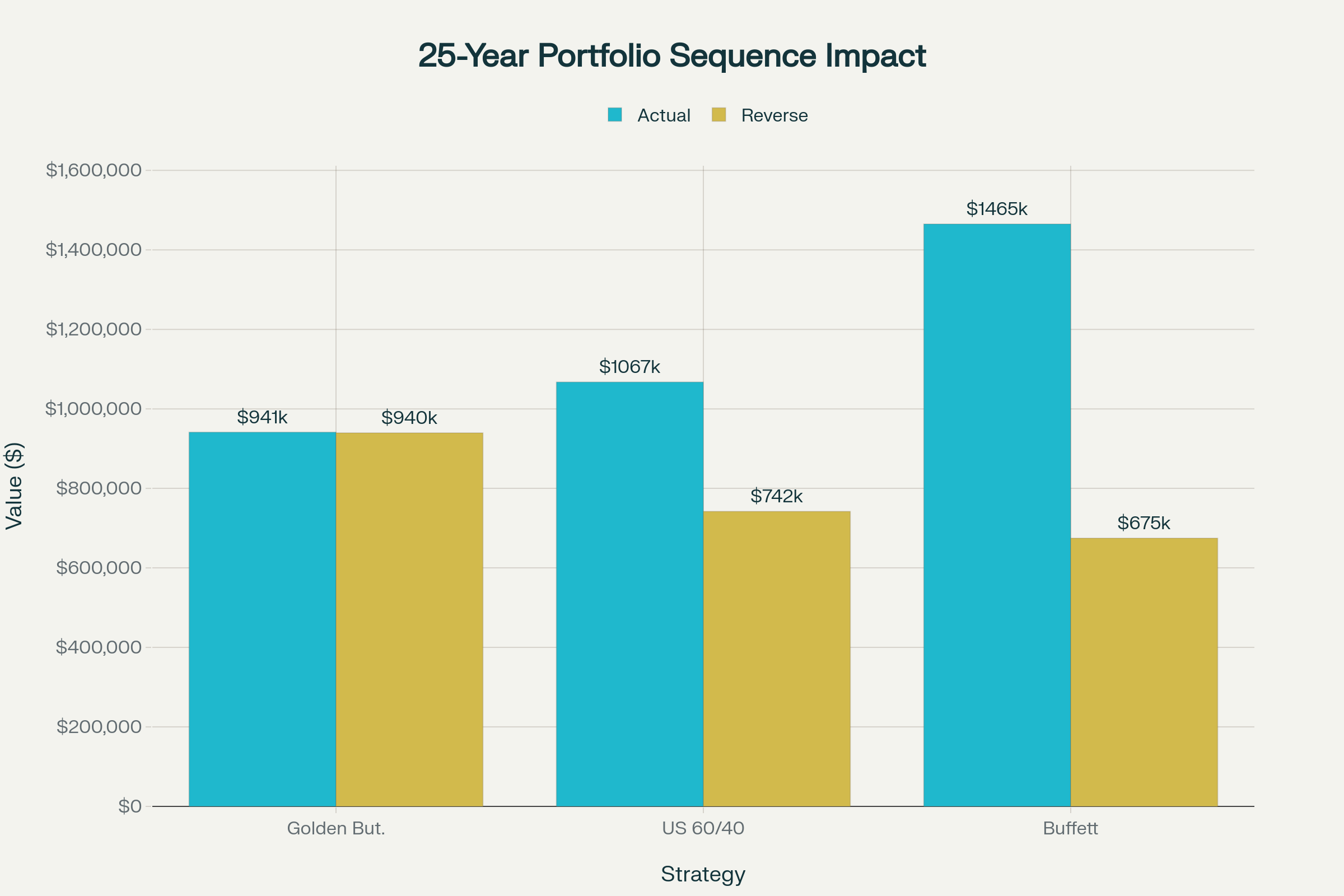
Bar chart illustrating how reversing the historical return sequence (2000-2024 vs. 2024-2000) dramatically alters final portfolio values across three strategies, despite identical time-weighted returns. Golden Butterfly represented with 20% allocation to the following assets: Large-cap stocks = VFINX; Small-Cap Value = VISVX; Intermediate Bonds = VFITX; ST Bonds = VFISX; Gold = Spot Gold Prices; US 60/40 = (60% = SPY; 40% = VFITX); Buffet 90/10 = 90% = SPY; 10% = VFISX. Data source is Portfolio Visualizer from January 1, 2000, through December 31, 2024, with annual rebalance and no advisor fees. These assets were chosen to reflect asset class data with longest available history. Past performance is not indicative of future results. Performance metrics are hypothetical and were not attained by actual investors.
NOTE: This analysis isolates one critical aspect of sequence-of-returns risk: the impact of CASH-FLOW TIMING. When you invest regularly (as most people do), the ORDER in which returns arrive dramatically affects your final wealth—regardless of the average return. This approach intentionally simplifies other complexities (like momentum, volatility clustering, and autocorrelation) to highlight the core insight: identical returns in different sequences produce vastly different outcomes when combined with regular contributions.
Why This Happens (And Why It Matters)
The phenomenon is called sequence of returns risk. But forget the jargon.
Here’s what matters: When you’re adding money regularly (your entire working career), timing becomes everything.
The Buffett portfolio got hammered early (2000-2002: -7.9%, -9.8%, -18.6%). But the portfolio was small. When massive gains came later (+28.5% in 2019), they multiplied a huge balance.
Flip it? Now you’re getting modest gains on a small balance, then catastrophic losses after you’ve built real wealth.
The math is brutal: A 50% loss requires a 100% gain just to break even. (Read more: The Math of Gains and Losses)
The Volatility Tax You’re Paying
Look at the annual volatility of these strategies:
- Golden Butterfly: 7.31%
- US 60/40: 10.20%
- Buffett: 16.26%
Higher volatility means more dramatic ups and downs. And volatility isn’t just uncomfortable—it’s expensive. (Read more: The Hidden Tax in your Portfolio)
This creates what’s called “volatility drag,” which is the difference between what your returns look like on paper (arithmetic average) versus what you actually experience (geometric compound growth). The more volatile your returns, the bigger the gap.
Think of it like this: If you gain 50% one year and lose 50% the next, you’re not back to even. You’re down 25%.
The Golden Butterfly lost only 0.21% per year to volatility drag.
The Buffett strategy? 1.22% per year.
Over 25 years, that’s not just numbers. That’s a new car every year. That’s years of comfortable retirement.
What You’re Really Choosing
When you pick an aggressive allocation like the Buffett 90/10, you’re not making a sophisticated investment decision.
You’re buying a lottery ticket.
You can’t control your sequence of returns. This is purely the luck of your life’s path. You’re betting on luck. You’re saying, “My timeline will magically align with favorable markets.”
The question isn’t whether the Buffett approach can work. It’s whether you can afford for it not to.
You’re essentially making a bet: “I believe my personal timeline will align with favorable market conditions.” Maybe you’re right. But what if you’re wrong?
And here’s the kicker: aggressive portfolios are almost impossible to stick with.
When the market drops 30%, 40%, 50% (which happens regularly), most investors panic and sell. They abandon ship at precisely the worst moment.
It’s easy to say “I’ll stay the course” when markets are up. It’s brutally hard when your life savings is evaporating and CNBC is screaming that the world is ending.
A strategy you can’t stick with is worse than a mediocre strategy you can maintain.
The Golden Butterfly’s lower volatility gives you a behavioral advantage. You’re more likely to stay invested through storms when drawdowns are moderate instead of apocalyptic.
And staying invested is what actually builds wealth.
But Wait—There’s a Better Way
Now, here’s where this gets exciting.
What if I told you there’s an approach that delivers:
- High returns
- Lower volatility
- Consistency that protects you from sequence risk
Sounds impossible, right? That’s what I thought too.
Let me introduce you to Dual Momentum (a.k.a. Tactical Asset Allocation).
In my final portfolio test, I applied Dual momentum to the Golden Butterfly allocation.
The results:
- Final value: $1,517,474 (highest of all strategies)
- CAGR: 22.25% (best money-weighted growth)
- Time-Weighted Return: 9.98% (nearly 3% higher than any static portfolio)
- Volatility: 11.28% (less than Buffett, only moderately higher than Golden Butterfly)
This isn’t a theoretical backtest using cherry-picked dates. Same 25 years. Same contributions. Same market conditions.
How is this possible?
Dual Momentum uses systematic rules to rotate between assets based on trends.
Not market timing. You’re not predicting. You’re responding.
When stocks trend up, you participate. When trends deteriorate, you shift defensive. The result? You capture upside while dramatically limiting downside.
That combination—gains without catastrophic losses—is how you compound wealth faster with less risk.
Why This Matters for Your One Shot at Wealth
You don’t get to run your life 1,000 times and average the results. You get one timeline through unknowable markets.
The critical question is this:
Do you want to bet everything on achieving optimal timing with a high-risk strategy, or do you want an approach that delivers strong results regardless of when you invest?
The Buffett portfolio’s forward sequence result ($1.38 million) looks attractive until you realize it could just as easily have been 56% less if returns occurred in reverse order. That’s not a strategy. That’s a coin flip with your future.
The Golden Butterfly’s consistency is impressive, with barely any difference between sequences. If I didn’t know about Dual Momentum, that’s what I would do.
But now that you’re aware of Dual Momentum, why not consider it?
Dual Momentum offers something different: the consistency to protect against bad luck, with the performance to capitalize on good fortune.
The Hidden Power of Systematic Approaches
Here’s what makes tactical approaches like Dual Momentum so powerful: they remove emotion from investing.
Every major investment mistake—buying at the top, selling at the bottom, chasing hot sectors, abandoning strategies at the worst time—comes from emotional decision-making.
A systematic, rules-based strategy forces you to do the right thing even when it feels wrong. When markets are soaring and you’re feeling invincible, the system might move you defensive. When blood is in the streets and you’re terrified, the system might have you buying.
It transforms investing from an act of faith into a process of probability management.
This Isn’t Without Trade-Offs
Full transparency: tactical allocation isn’t perfect for everyone.
It works best in tax-advantaged accounts like IRAs and 401(k)s, where frequent rebalancing doesn’t trigger capital gains taxes. In taxable accounts, you need to weigh the tax impact against the performance benefits.
It requires discipline. You’re going to hate the strategy sometimes, and it’s usually right before it proves its worth. During choppy markets, when it moves to cash, you’ll feel like you’re missing out. During the early parts of a market recovery when it’s only partially invested, you’ll watch others brag about bigger gains.
The system works over full market cycles, not month to month.
It’s not the absolute highest performer in every scenario. In a perfectly smooth, endlessly rising market, simple buy-and-hold would beat it.
But we don’t live in that world.
Your One Shot Deserves Better
Keep doing what everyone does: pick an allocation, close your eyes, and hope for the best.
Or adopt an approach designed to navigate uncertainty, protect against catastrophe, and capitalize on opportunity.
The difference isn’t small. It could be the difference between $1.5 million and $639,000. Between comfort and discomfort.
My preference? Tactical asset allocation. But you don’t have to see it that way.
Maybe you prefer a static allocation like the Golden Butterfly. If so, that’s great news. You see the value of consistent returns over hoping for big returns.
Want to understand how tactical allocation works and whether it fits your situation? Read: Tactical Asset Allocation: Navigating an Unknowable Future.
Ready to explore whether this approach makes sense for you specifically? That’s exactly the conversation we have with clients. No sales pitch, no pressure, just an honest assessment of where you are, where you want to go, and whether our approach can help you get there with less risk and more confidence.
Continue reading more of our insights by visiting our resources page. If you’re ready to see how we can partner with you on your wealth plan, please contact us today for a complimentary introductory call.
Because you only get one shot at building lasting wealth. Don’t leave it to luck.