
When it comes to investing, I’m a believer in finding a strategy you can stick with for the long run. There’s no “easy button” for that, which is why education is your best tool.
The challenge?
Most of us lack the time, talent, and temperament to become experts.
Yet we owe it to ourselves to do some due diligence: to understand how our investment strategy has performed across different market environments. Not to become gurus, but to become informed.
In this article, I’ll break down the simplest path I can think of to build that understanding.
Let’s dive in.
Investment 101: The Foundations
Start here: Meb Faber’s Global Asset Allocation is the best single resource on this topic. You can download the e-book free, or listen to the audio version if you prefer.
This resource teaches three critical takeaways:
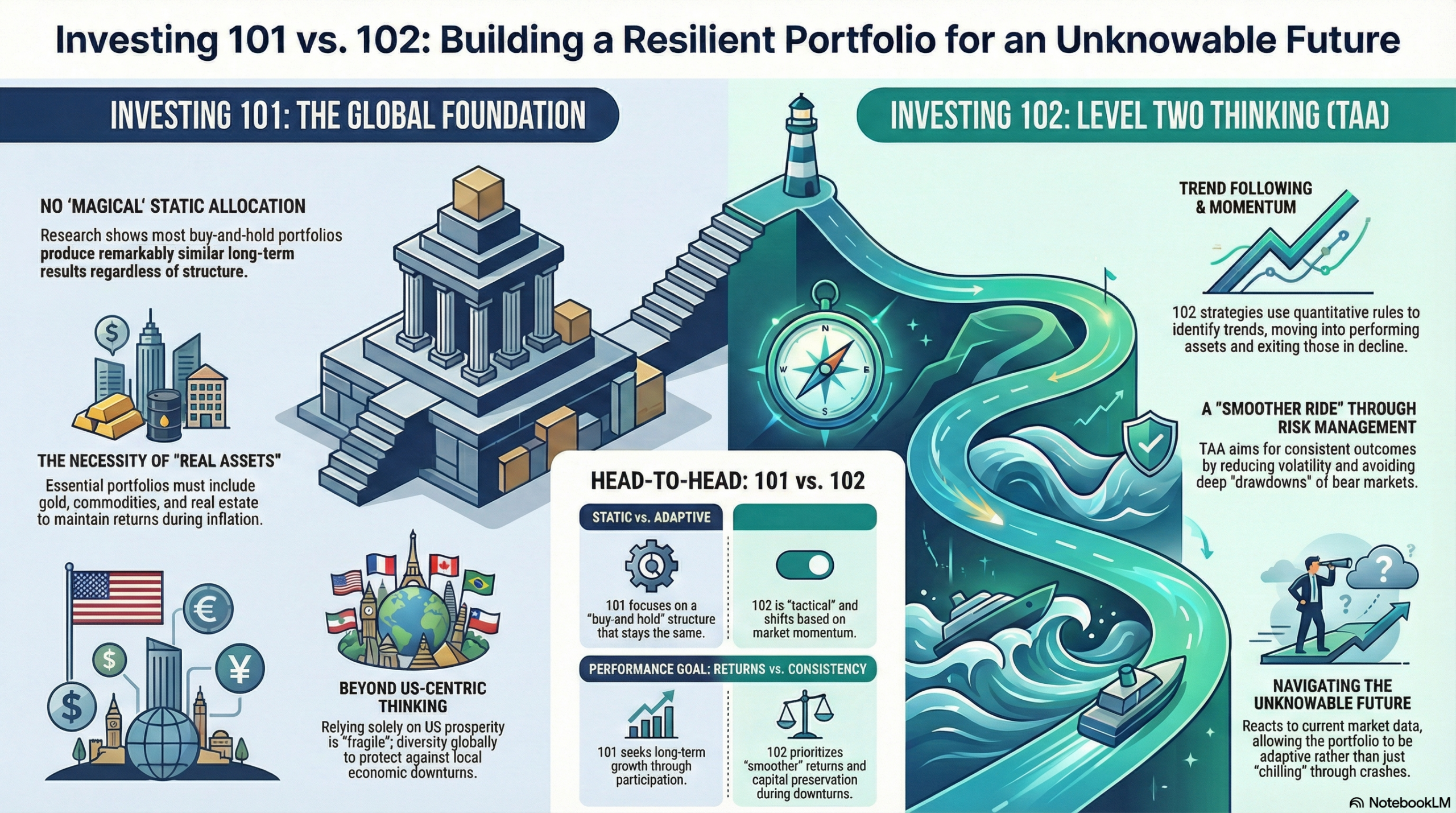
1. There’s no magical asset allocation.
Buy-and-hold portfolios ultimately produce similar long-term results regardless of how you structure them. Faber proves this by studying 13 different asset allocations.
The implication? Chasing the “perfect” allocation is likely a waste of energy.
2. Real assets matter during inflationary environments.
Gold, commodities, and real estate aren’t fancy add-ons.
They’re essential for consistent, positive returns when inflation runs.
Here’s the uncomfortable truth: We’re in 2025, and inflation is here. Do you have any real assets in your buy-and-hold portfolio?
If you’re holding only US stocks and bonds, you might want to know how that mix performs when prices are rising.
3. Trend following (aka Tactical Asset Allocation (TAA)) and value investing are the key areas that outperform buy-and-hold.
Specifically, TAA delivers more consistent outcomes—not just higher returns, but smoother rides.
The bottom line: I hope this resource shifts your perspective on diversification. Owning something beyond US equities and US bonds isn’t exotic. It’s prudent.
For more on this, check out my article on consistency vs. luck in retirement investing.
“Diversification’s nemesis is FOMO—by definition you’re always going to have some regret. It’s investors’ job at the end of the day not to look backward but forward to what’s the best portfolio to navigate the next decade.”
– Jordan Brooks, a principal and co-head of the Macro Strategies Group at AQR Capital Management.
Investment 102: The Next Level
If you’re a die-hard Boglehead or Vanguard investor, please keep an open mind as you read this. I get it…I was there too.
I still respect the low-cost index investing philosophy (“US equities, US bonds, and chill”). But I’ve moved beyond it, and here’s why.
A dangerous half-truth. My shift started when I researched market history and retirement distribution planning in depth. What became clear: buy-and-hold indexing is a great starting point, but treating it as the complete answer is dangerous.
Here’s the paradox: Many takeaways from Global Asset Allocation actually support the Boglehead approach. But where they diverge—and where this gets important—is on the role of real assets in inflationary periods.
We’ve had 15 years of US stock and bond dominance (see Cambria’s “Bear Market in Diversification” paper or audio). That’s long enough to convince people it’s the only way to invest.
Yet when you look under the hood at market history, you realize the risk of relying on just one economic outcome—US prosperity—as your sole source of returns. That’s fragile.
Level two thinking. A few simple rules can change that.
I invest 100% of my personal portfolio using what I call “level two thinking”(i.e., strategies built on trend following and momentum).
I don’t expect everyone to follow this path. But I do hope anyone who reads this will genuinely consider the first resource and the case for true global diversification, especially in retirement.
Your Learning Path (Pick Your Depth)
Choose your own adventure:
For a quick 30,000-foot overview: Only watch Video 2 (below).
For a solid 10,000-foot understanding: Watch Videos 1, 2, and 3 in order.
To dive deep and get into the weeds: Work through all materials in the order listed.
Resources (In Recommended Order)
- Global Asset Allocation (Meb Faber)
- Bear Market in Diversification (Cambria)
- My deep-dive: Tactical Asset Allocation: Navigating an Unknowable Future
- Academic foundation: A Quantitative Approach to Tactical Asset Allocation *(referenced in the Global Asset Allocation PDF—heavy reading, but Video 2 summarizes it)* Click here for the audio summary.
- Video 1: Introduction to Tactical Asset Allocation
- Video 2: TAA in Action (10,000-foot view of the research)
- Dual Momentum deep-dive:
-
- Dual Momentum Overview
- Video 3: Dual Momentum Primer *(Note: Author’s opinion heavy, but good intro)*
- Video 4: Deep Dive into Dual Momentum
- Executive Summary: Relative & Absolute Momentum (includes links to research papers)
- Why Dual Momentum Outperforms
- If you work through these materials and feel skeptical of level-two thinking, that’s okay. I have more to share. We’ve just scratched the surface here.I’d genuinely love to hear your thoughts once you’ve explored these resources. Whether you embrace level-two thinking or remain unconvinced, I’m here for the conversation.
Ready to explore a personalized investment strategy for your situation? Contact us today for a complimentary introductory call.
Investment 101.5: When in Doubt, Go 50/50
While it’s easy for me to see the value of Level 102, I know it’s not for everyone.
It’s a new concept. It runs counter to many of our long-held beliefs about investing.
If that’s you, then consider a combination of a Global Asset Allocation and a Tactical Asset Allocation. Heck, I’m even open to the idea of a Global Equity Asset Allocation + TAA.
As an advisor, I have two jobs:
- Help you not run out of money.
- Help you stick to your investment plan.
There’s nothing worse than starting an investment plan you’re not committed to, only for you to bail on it during a period of adversity.
There’s no holy grail in investing. Every strategy will go through a period of choppy or negative performance. Ultimately, you should choose the strategy that gives you the highest probability of success for your plan AND that you can stick to.
Your Biggest Risk
Everyone wants growth in their portfolio. And since 2009, that’s exactly what investors have gotten from doing one thing right: owning U.S. equities. The more exposure, the better it seemed. Anything else looked foolish.
But long, beautiful runs like this often end the same way—with a season of disappointment for the dominant asset class. It’s called a lost decade.
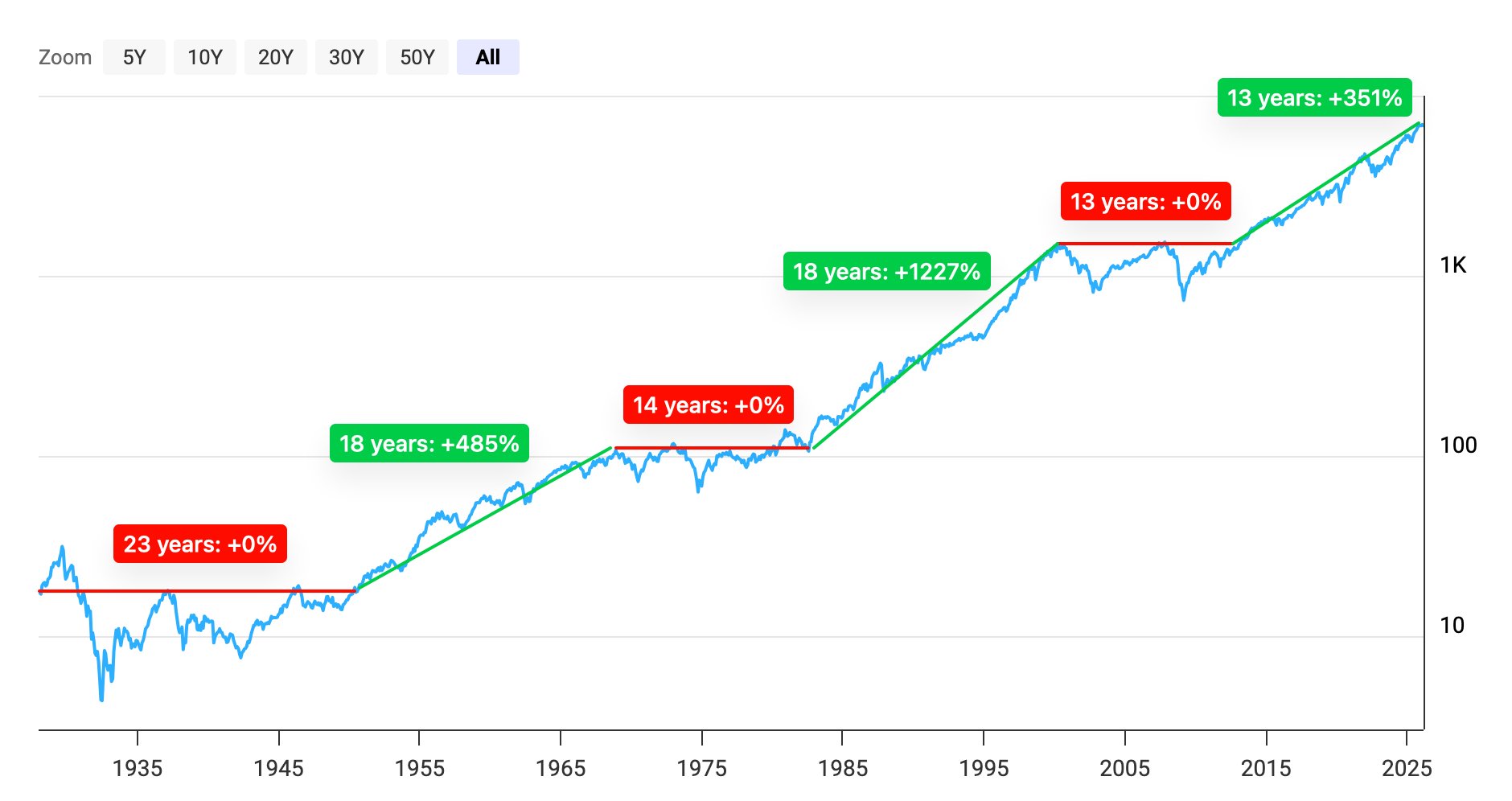
This isn’t about fear. It’s about realism. Markets move in cycles, and leadership always changes. Maybe the next lost decade is far off. Maybe this time truly is different. No one knows
What we do know is that if a lost decade arrives and catches your portfolio flat-footed, the impact on your retirement plan could be significant. That’s why I offer two clear paths—Options 101 and 102—to help you reduce the risk of that outcome.
Ultimately, it’s your plan and your future. My role is to help you see the full picture, not just the highlight reel.