

With Halloween on its way, candy might be on your mind, but the one treat you don’t want in your investment basket is “Boomer Candy.”
These so-called safe havens promise stock-like returns with minimal risk, but they often leave portfolios with more cavities than gains.
What Exactly Is Boomer Candy?
Boomer Candy refers to buffered ETFs, downside protection ETF, defined outcome funds, structured notes, and similar products.
They’re designed to deliver a capped range of returns over a fixed period, usually one year, using options or gain limits.
The pitch? Enjoy some upside while buffering downside—sounds like the holy grail, right?
In reality, it’s a trade-off: limited gains for partial protection. But with markets rising about 70% of the time, you’re often sidelining yourself during bull runs.
The Sweet Side: When It Might Work
These products shine as a steppingstone for ultra-cautious investors stuck in cash, CDs, or money markets.
Market volatility can rattle even the steadiest nerves, especially since 2021, when stocks and bonds started moving in tandem, making portfolios feel riskier with losses across the board. This behavioral tug-of-war—fearing short-term dips while needing long-term growth—is real. But this is why we prefer Tactical Asset Allocation (TAA) anyway: It dynamically adjusts to cut losses early without capping your upside, backed by data, not just promises.
If market volatility causes you significant emotional stress but your retirement plan requires that you need to dip a toe in equities, they can help transition to real risk—emphasis on temporary use.
The Sour Reality: Hidden Drawbacks
Marketers tout this as a “free lunch,” but there’s no such thing.
You sacrifice big upside for modest protection, like buffering the first 10% of losses while exposing the rest. Routine 10% drawdowns? That’s just investing. For short-term needs (1-2 years), stick to T-bills.
Just like settling for candy that might leave you with a tummy ache, these products often deliver flat or even negative real returns after fees if markets are meh.
Compare that to boring-but-reliable Treasuries:
A one-year Treasury today guarantees about 3.8%, while Boomer Candy might net you -0.5% to 6.5% (after expenses), with only a 64% chance of beating that Treasury yield. Why gamble on candy when you can have a sure snack? Source: Kitces
Worse still, studies from AQR (click here) show these funds often lag a simple equity-cash mix with similar risk.
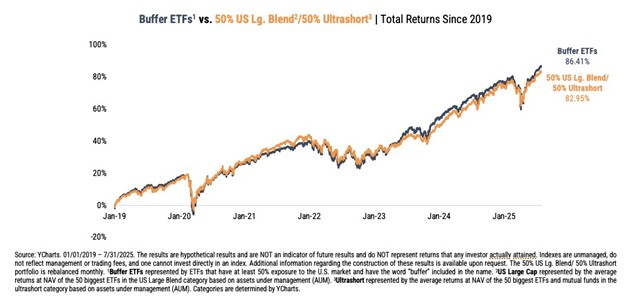
Over 100 years of S&P 500 data show the sour truth:
In 58% of rolling 12-month periods, markets exceeded typical 7% caps on these products, averaging 18% in positive years. You’d match the market only 13% of the time, missing out on bull runs while “protecting” against the 29% negative periods. That’s like trading a full candy bar for a few crumbs—tasty in theory, but unsatisfying in practice. (Source: Kitces)
They’re short-term bets, requiring annual resets that amp up unpredictability. And intra-period volatility can sting: A early market dip might show temporary losses as options price in worst-case scenarios (source: ETF Trends).
Timing is everything with this candy—buy mid-cycle, and that “protection” melts away. If the fund’s price has risen since the start, you could still lose up to 3-4% (or more) before hitting the floor, despite the no-loss hype. It’s like biting into chocolate that’s already half-melted: The wrapper promises perfection, but reality delivers a mess. (Source: Kitces)
Don’t ignore the sales machine—wholesalers pitch these products to me weekly. Why? Probably because they’re profitable to sell. Hmmm.
If an advisor pushes Boomer Candy, ask how much of their money is in it.
A Better Bite: Tactical Asset Allocation (TAA)
Downside protection is crucial for retirement, but TAA does it smarter by letting winners run while cutting losses early (click here to learn about TAA).
TAA is backed by over 100 years of data (AQR study; SSRN paper), TAA consistently performs without the hype. It doesn’t sell as easily as buffered products because it challenges conventional wisdom, but that’s often where the real edge lies.
The evidence is so compelling that I’ve invested 100% of my assets (and my family’s) in TAA. Not everyone will agree, and that’s fine. If TAA isn’t for you, at least opt for a solid buy-and-hold (e.g., cash + equities) mix over Boomer Candy.
If these products tempt you, use them sparingly as a bridge to historically proven strategies.
Ready to protect your nest egg without the sugar crash? Schedule a consultation at Calculated Wealth LLC to discuss personalized strategies.
Continue reading more of our insights by visiting our resources page. If you’re ready to see how we can partner with you on your wealth plan, please contact us today for a complimentary introductory call.
Schedule an Introductory Call
Calculated Wealth LLC(“Calculated Wealth”) is a registered investment adviser, registered with the SEC. Registration does not imply a certain level of skill or training. The presence of this website on the Internet shall not be directly or indirectly interpreted as a solicitation of investment advisory services to persons of another jurisdiction unless otherwise permitted by statute. Follow-up or individualized responses to consumers in a particular state by Calculated Wealth in the rendering of personalized investment advisor for compensation shall not be made without our first complying with jurisdiction requirements or pursuant to an applicable state exemption. All written content on this site is for information purposes only. Opinions expressed herein are solely those of Calculated Wealth, unless otherwise specifically cited. Material presented is believed to be from reliable sources and no representations are made by our firm as to another parties’ information accuracy or completeness. All information or ideas provided should be discussed in detail with an advisor, accountant, or legal counsel prior to implementation.
©2023-2025 – Calculated Wealth. All rights reserved. | Privacy Policy | Download Client Relationship Summary
Designed by Peko Designs